
Before you trust anyone’s horse-racing analysis, you should know who is behind it, what they believe, and what happens when the evidence disagrees with the story they would like to tell.
That is especially true in a game overflowing with numbers, opinions, angles and uncertainty.
So let me start there.
Who is behind HCRALabs?
I spent 35 years in capital markets, and a large part of that career sat at the intersection of technology, data and investment decision-making. I was the technology leader behind fixed-income and equity trading systems, asset and portfolio-management platforms, risk-management systems, and capital-markets data capabilities across Fortune 100 multinationals and global data vendors.
My work with capital-markets data added another discipline: caring deeply about questions that sound simple until money depends on the answers. What does this data actually mean? Where did it come from? Can it be reconciled? Is it complete? Is it being used in the right context? Can the conclusion be reproduced? What are we pretending to know that the evidence does not really support?
Capital markets taught me that data does not create an edge simply because you have more of it. The advantage comes from knowing what the data means, whether it can be trusted, how it fits the decision in front of you, and what the market may already have priced in.
Horse racing is a very different market, but the analytical problem has familiar characteristics: incomplete information, uncertain outcomes, competing signals, prices that incorporate collective opinion, and decisions where being right is not enough if the price is wrong.
I am also a lifelong racing fan.
I do not claim that a résumé wins races. But I do believe the combination is unusual: a lifetime around racing, decades building technology and data capabilities for capital markets, experience with trading, portfolio and risk management systems, and professional expertise in managing the data that fuels those businesses.
HCRALabs grew out of bringing those worlds together.
The horseplayer in me wants to know: What do I do with this race?
The data professional in me asks a different question first: What information in this race is trustworthy enough to influence that decision?
None of that means you should trust a pick because of my résumé. It means I built HCRALabs with a particular set of instincts: trace the data, challenge the assumptions, preserve chronology, and do not confuse a compelling story with evidence.

That distinction is the foundation of HCRALabs.
This has not been a weekend spreadsheet
For nearly two years, I have been building HCRALabs the unglamorous way: late nights, weekends, race after race, working through data definitions, chronology, identity, horse-level class inference, market information, modeling, validation, machine learning, simulation and the long list of things that have to be right before the final output can be useful.
Some nights end with a better capability. Others end with an idea being discarded, an assumption being corrected, or work being rerun because the evidence did not hold up.
For the tracks I cover, my historical race data goes back to the beginning of 2023. Every race I process works through more than 1,500 data points per entry. In a typical field, that means more than 10,000 data points can sit behind a Race Sheet designed to show only what deserves attention.
The volume is not the point. The discipline is deciding what earns its way onto the page—and what does not. Discipline is the will to kill it.
Some of the most important progress in HCRALabs has come from proving that something I thought might matter did not deserve to matter after all.
Before asking who wins, ask what you can trust
A race can be full of facts and still be short on evidence.
Speed. Pace. Class. Form. Trips. Trainers. Jockeys. Surface. Distance. Post position. Pedigree. Workouts. Running style. The betting market.
The hard part is not finding information.
The hard part is deciding what deserves to matter in this race.
A statistic can be correct and still be useless. A pattern can look impressive and still be fragile. An angle can have a strong historical record and still add almost nothing once you account for context, overlap with other information, or what the market already knows.
I do not want the biggest pile of racing information.
I want the smallest set of information that is trustworthy, relevant, materially useful and distinct enough to deserve a place in the decision.
Sometimes that strengthens an opinion. Sometimes it weakens one. Sometimes it says there is less separation in the race than I hoped to find.
All three outcomes are useful.
Data quality is part of handicapping
Quantitative handicapping starts before the model.
Horse identity, trainer and jockey identity, race chronology, class, surface, distance, conditions, results and market information all have to mean what we think they mean before anything built on top of them deserves confidence.
That may sound like plumbing. It is not.
Bad data does not become good analysis because the model sitting on top of it is sophisticated. It just becomes a more sophisticated way to be wrong.
One of the easiest ways to fool yourself with historical racing data is to let the future leak quietly into the past. Records get corrected. Statistics get recomputed. Identities and histories become more complete. Information that looks historical today may not have been known on the morning of the race.
So I care about more than whether a number is historically accurate. I care about whether I could legitimately have known it at the moment the decision had to be made.
So one rule behind HCRALabs is simple:
Truth before modeling.
If an input cannot be trusted, I would rather exclude it than give it false precision because it fits neatly into a calculation.
Complexity has to earn its keep too
I use statistical modeling, machine learning and simulation where they add value.
But complexity does not impress me by itself.
A more complicated method has to demonstrate that it contributes something a simpler method does not. If it cannot do that under disciplined testing, it does not earn a place merely because it sounds advanced.
The same rule applies to a clever statistic, an intuitive angle or a model feature.
Does the relationship persist? Is it driven by a small number of observations? Does it work where I intend to use it? Does it add information beyond what is already captured elsewhere? Does it survive when the wagering market is treated as a serious benchmark rather than ignored?
If the answer is no, the idea gets downgraded, suppressed or discarded.
That, more than any single metric or model, is what I believe makes HCRALabs different: the system is designed to be skeptical of itself.
That is not failed research.
That is research doing its job.
The race in front of you matters more than an isolated number
A horse does not run against its own past performance.
It runs against the horses in today's field, under today's conditions, at today's price.
A number that looks strong in isolation may be ordinary relative to the field. A horse with an attractive historical profile may face several rivals with equally strong or better evidence. A factor that matters in one type of race may contribute very little in another.
So instead of asking only, Is this good?
I want to know:
What does this tell me about this horse, against these horses, under today's conditions?
That field-relative, race-specific view is a major reason a compact Race Sheet can require so much work.
The job is not to display everything that can be calculated. It is to decide what survives the comparison.
Uncertainty is information
Real races rarely resolve into a clean spreadsheet where every piece of evidence points to the same horse.
One horse may be strongest in one area and vulnerable in another. Another may look less obvious but fit the race unusually well. The betting market may reinforce the analysis, challenge it, or make an initially interesting horse much less interesting at the available price.
I do not want to hide that conflict.
It is the race.
Some races produce a clear hierarchy. Some do not. Sometimes the responsible conclusion is that the evidence does not justify strong separation.
Uncertainty is not a defect to be edited out of the analysis. It is part of the information.
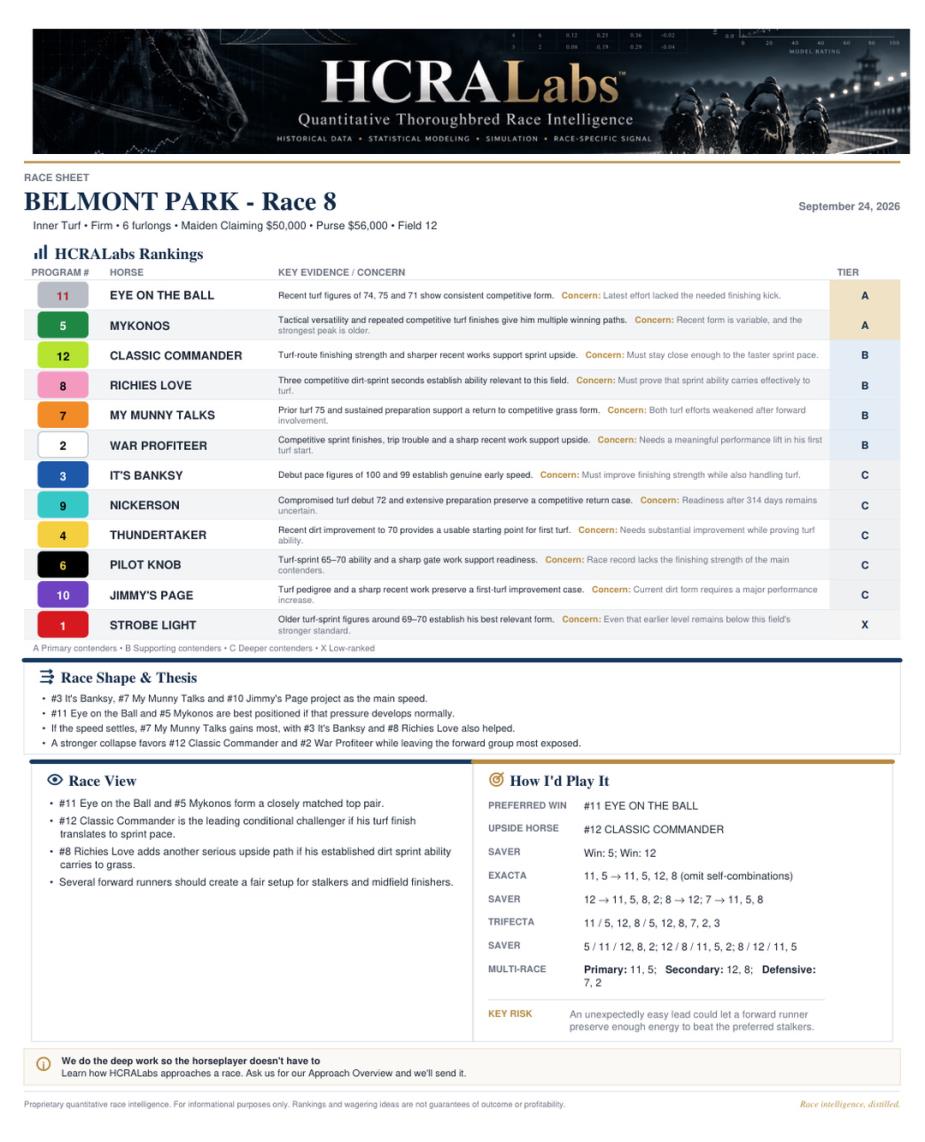
That is why the HCRALabs contender tiers are a hierarchy, not a promise:
- S — strongest conviction, when warranted
- A — primary contenders
- B — supporting contenders
- C — deeper contenders
- X — low-ranked
An A horse can lose. A C horse can win. An X horse can win.
That is racing.
The purpose is to show where the evidence is concentrated and where conviction falls away before the race is run.
Why the Race Sheet leaves things out
The Race Sheet is the final compression of a much larger analytical process. It is intentionally concise. The work behind it is not.
Internally, I can examine far more information than I would ever want to put in front of a horseplayer.
A Race Sheet should not be a research dump. It should be an interface.
If a metric adds nothing useful, it does not belong there. If a signal does not survive scrutiny, it does not belong there. If two pieces of information are saying essentially the same thing, I do not need to show both just to make the analysis look sophisticated.
And if nothing is important enough to call out, I would rather leave space on the page than manufacture a story.
Signal has to earn its way onto the page.
The objective is not more information.
It is more useful information.
Transparency does not mean publishing the recipe
Trust matters. So does intellectual property.
I want horseplayers to understand the discipline behind HCRALabs. I am comfortable explaining the principles: data integrity, strict pre-race chronology, validation, uncertainty, market awareness, modeling, machine learning, simulation, accountability, and why some information is surfaced while other information is suppressed.
I am not going to publish the exact weights, formulas, thresholds, feature construction, model internals or other implementation details that would make the work replicable.
There is a difference between explaining why a conclusion deserves to be taken seriously and handing over the proprietary machinery that produced it.
The Race Sheet is the user interface.
The analytical machinery behind it is what I have spent nearly two years building.
The result is part of the research
The analysis does not end when the horses leave the gate.
What was published before the race has to remain the reference point afterward.
If the top-ranked view was wrong, it was wrong. If a deeper contender won, that matters. If a wagering idea failed, I do not want to rewrite the result into a victory because some other part of the analysis happened to be directionally right.
The same discipline applies to good days. One winner does not prove a model, and one losing day does not disprove one.
What matters is the prospective record that accumulates over time: what was said before the race, what happened, where the analysis helped, where it failed, and what repeated results tell us.
The misses are data too.
That may be the most important thing I can tell you about how I intend to run HCRALabs.
Why I'm giving the picks away
Right now, I am publishing HCRALabs Race Sheets and picks without charging for them.
That is deliberate.
If I eventually expect someone to pay for this work, I think I should first give people the opportunity to watch it operate in the open.
I am not asking anyone to subscribe on faith. I want people to see what HCRALabs says before the race, watch the results accumulate, see the good days and the bad ones, and decide for themselves whether the work is useful.
Publishing the analysis now also gives me something I value enormously: a growing prospective record. Every race puts the system under another real-world test. Every result becomes another opportunity to learn where the approach is strong, where it is weak and where the product needs to improve.
Free does not mean I believe the work has no value.
It means I believe trust should be earned before I ask someone to pay for it.
What HCRALabs is becoming
HCRALabs is not intended to stop at picks and Race Sheets.
Ranking horses is only part of the problem. The more economically interesting question is where the evidence and the wagering market disagree.
That is one of the areas HCRALabs is moving toward: market-edge analytics designed to help identify when the evidence surrounding a horse, trainer, race shape or other supported factor may not be fully reflected in the price.
Over time, I also intend to open useful portions of the HCRALabs data and analytical platform to customers— not the proprietary machinery, but governed data and intelligence that serious horseplayers can explore for themselves.
And ultimately this should not live only in a PDF. Horseplayers make decisions at the track, in the paddock, at the sportsbook and on the move. A mobile HCRALabs experience is a natural part of where this is going.
I am deliberately not putting dates on features before they are ready.
The same rule applies to the product that applies to the analysis:
It has to earn its way into production.
What a customer will eventually be paying for
When HCRALabs becomes a paid product, customers will not be buying certainty.
They will not be buying a promise that every top-ranked horse wins, and they will not be buying a screenshot of a winner after the fact.
The picks are free today. The underlying capability is what I am building into a business.
Eventually, what a customer will be paying for is the work required to make those picks—and the broader intelligence around them—worth considering.
That means a process designed to:
- start with data that has been cleaned, reconciled and governed rather than blindly accepted;
- test ideas instead of falling in love with them;
- separate historical coincidence from evidence that has a better chance of persisting;
- use race-specific context rather than statistics in isolation;
- account for what the wagering market may already know;
- use modeling and machine learning without confusing complexity with quality;
- acknowledge uncertainty instead of manufacturing conviction;
- preserve what was said before the race so the work can be judged afterward.
My goal is not to give you more reasons to bet.
It is to give you fewer bad reasons.
A paid racing product should earn its price by reducing noise, saving you time and improving the quality of the decisions in front of you.
That is the standard I am building toward.
What I want HCRALabs to stand for
I want HCRALabs to become a place serious horseplayers can go when they want more than another opinion.
Not certainty. Not locks. Not hindsight.
A disciplined view of what the evidence actually says, what the market may already know, where uncertainty remains, and what deserves attention before money is put at risk.
The larger question is not simply: Who wins?
It is:
What evidence in this race is trustworthy, relevant and important enough to influence a decision—and what should be ignored?
The rankings are one expression of that work. Race View is another. Wagering structure is another. Post-race review is another.
The system will keep evolving as more races put the work under pressure and show where it is useful, where it is not, and where it needs to improve.
And there is no expectation that you should trust me merely because I tell you the work is rigorous.
Judge the work, not the pitch
For now, the work is free. So judge it.
Read the Race Sheets before the races. Watch what happens. Notice the misses as well as the wins.
If the work earns your trust over time, I hope HCRALabs will eventually earn your business too.
Because in a game overflowing with data, the advantage may not come from knowing more.
It may come from knowing what deserves to matter.